
Phones still ring. A lot.
Despite chatbots, emails, WhatsApp messages, and every new communication channel that seems to appear overnight, customers still pick up the phone when they need answers quickly. They call to book appointments. They call to check the order status. They call because they don't want to wait for an email response.
And that's where many businesses hit a wall.
A support team can only answer so many calls. A sales representative can't be available twenty-four hours a day. Missed calls pile up. Opportunities slip away. Customers get frustrated.
Simple.
Expensive.
Avoidable.
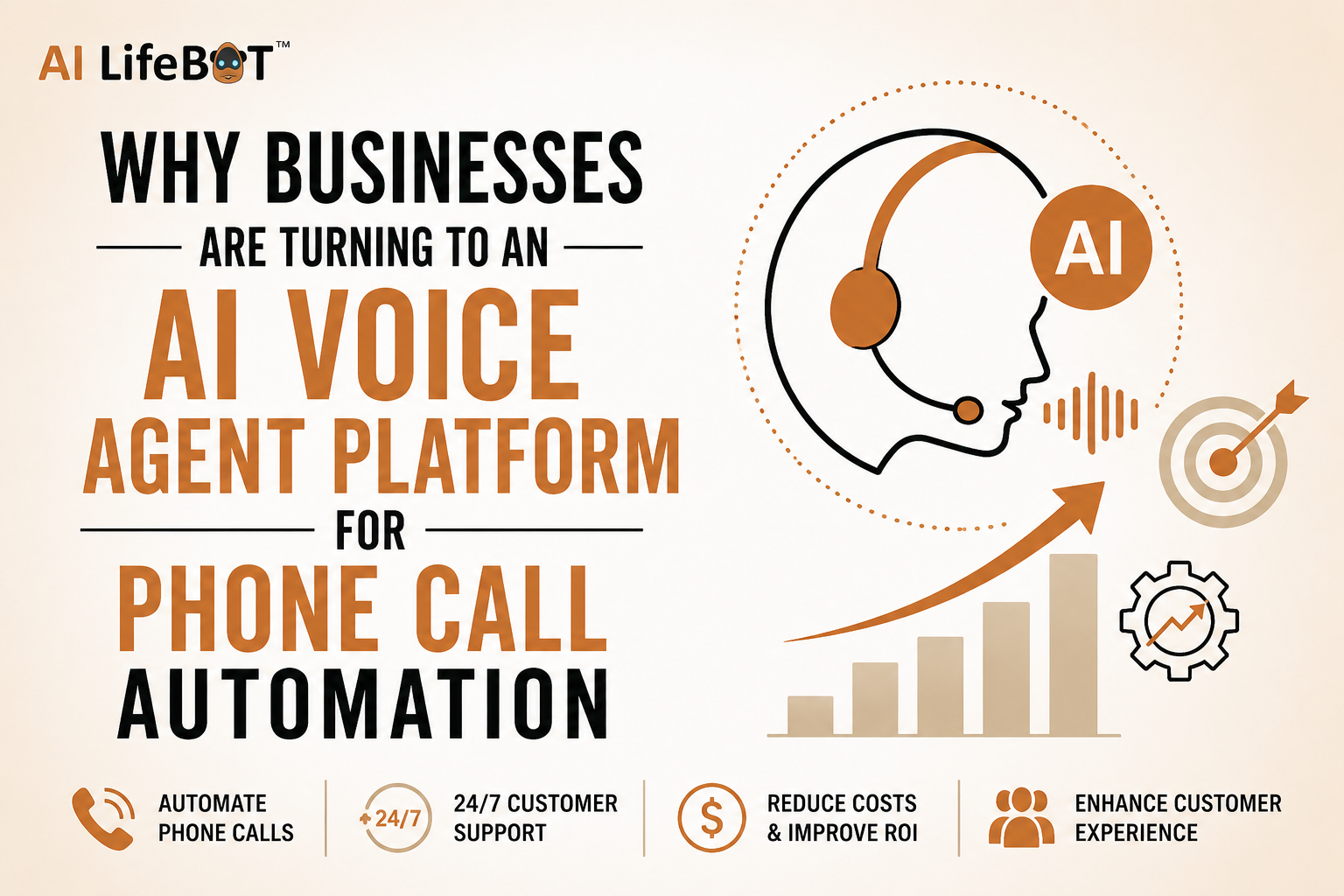
This is exactly why businesses are increasingly adopting AI Voice Agents to automate phone conversations without sacrificing customer experience. Platforms such as AI LifeBOT are helping organisations handle thousands of conversations simultaneously while maintaining the natural flow people expect when speaking over the phone.
Think about it for a moment. Imagine a busy clinic receiving hundreds of appointment enquiries every day. The receptionist is already juggling patient check-ins, paperwork, and emergency requests. The phone keeps ringing. Nobody is intentionally providing poor service, but there's only so much one person can do before things start falling through the cracks.
That's where an intelligent AI voice system changes the equation.
Instead of placing callers on hold, AI Voice Agents can instantly answer incoming calls, understand customer intent, provide information, schedule appointments, verify details, and even transfer complex cases to human representatives when necessary. The customer gets assistance immediately. The staff focuses on higher-value tasks. Everybody wins.
Mostly.
Because here's the thing: not all voice automation platforms are created equal.
Customers can spot a robotic, scripted phone system from a mile away. We've all experienced it. You ask a simple question, and the system responds as if it belongs in a customer service museum from 2008. Frustrating doesn't even begin to cover it.
Modern AI Voice Agents work differently. They understand context, recognise natural speech patterns, and respond conversationally. Instead of forcing callers through endless menu options, they listen, interpret, and react in real time.
Human-like.
That's the goal.
AI LifeBOT has positioned itself as a powerful platform in this space by enabling businesses to deploy advanced voice automation solutions across customer support, sales, operations, recruitment, and service functions. Rather than treating every caller the same, the platform can personalise interactions based on customer information, previous conversations, and business workflows.
The result feels less like speaking to a machine and more like interacting with a knowledgeable assistant who simply happens to be available all day and all night.
Now consider what happens in a sales environment.
A potential customer discovers your business at 11:30 PM. They call with questions. Nobody answers. The lead disappears by morning.
Not because your product wasn't good enough.
Not because your pricing was wrong.
Because the phone rang and nobody picked up.
An AI Voice Agent doesn't sleep. It doesn't take breaks. It doesn't call in sick on Monday morning. It can answer enquiries, qualify leads, collect customer information, and schedule follow-up appointments instantly. That means businesses capture opportunities that might otherwise vanish before a human team even starts work.
Which brings us to another important point.
Scale.
Traditional call centres require additional staff as call volumes increase. More calls usually mean more hiring, more training, more infrastructure, and higher operational costs. Voice automation flips that model. An AI-powered system can manage large volumes of simultaneous interactions without dramatically increasing costs.
That's a significant advantage for growing organisations.
Particularly in competitive markets.
The demand for AI Voice Agents in Delhi has grown rapidly as businesses across healthcare, education, finance, retail, logistics, and real estate look for smarter ways to manage customer communication. In a city where business never really slows down, customers expect immediate responses. Waiting until tomorrow is often not an option.
Businesses that adapt gain an edge.
Those that don't?
Well, customers have alternatives.
AI LifeBOT helps bridge this gap by combining conversational intelligence with enterprise-grade automation capabilities. Whether handling customer enquiries, processing service requests, generating leads, or supporting internal operations, the platform allows organisations to create efficient communication workflows without losing the personal touch customers value.
And that's what makes this technology so interesting.
It's not really about replacing people.
It's about removing the repetitive, time-consuming tasks that prevent people from focusing on work that genuinely requires human judgement, empathy, and creativity. Nobody dreams of spending eight hours answering the same routine question hundreds of times. AI can handle that.
People can handle the rest.
As customer expectations continue to rise, businesses need communication systems that are fast, available, and intelligent. AI Voice Agents are no longer a futuristic concept reserved for large enterprises. They are becoming an essential business tool.
The companies embracing phone call automation today are preparing for a future where responsiveness isn't a luxury.
It's expected.
And platforms like AI LifeBOT are helping make that future possible.