
Businesses used to automate tasks.
Now they’re automating decisions.
That’s the interesting part.
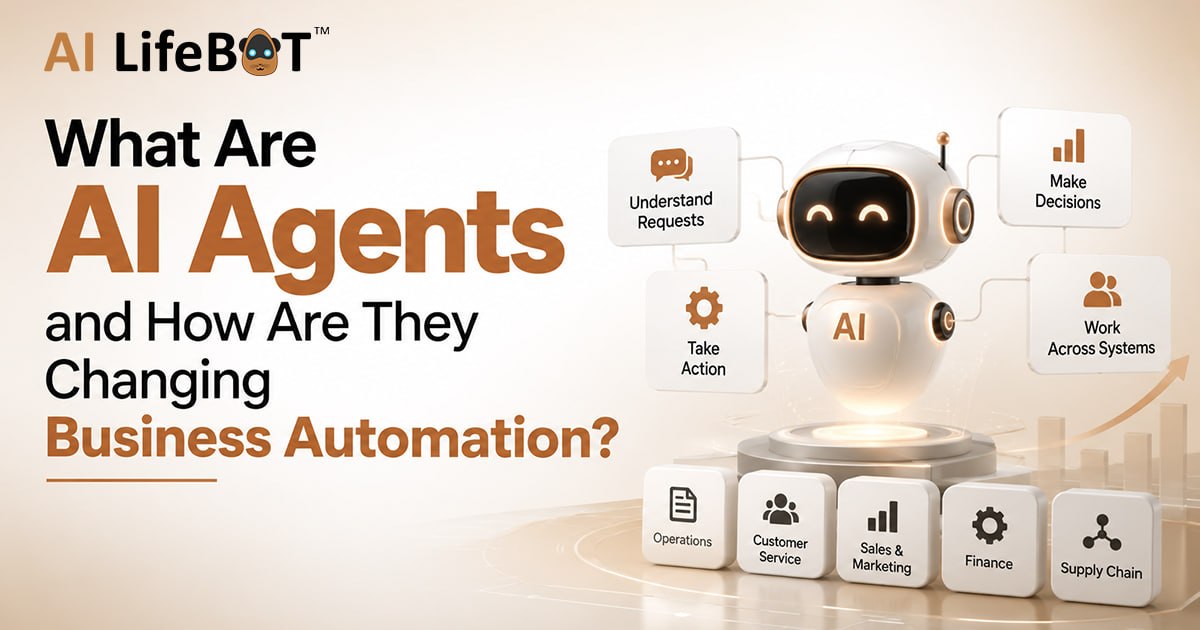
An AI agent isn’t simply a chatbot waiting for someone to type a question. It can understand an objective, interpret information, decide what needs to happen next, use connected tools, and carry out a sequence of actions with far less hand-holding than traditional automation. Think of it as the difference between setting a microwave timer and giving someone a simple instruction: “Get this done.” The second one requires judgment.
That shift is changing business automation rather quickly.
So, What Exactly Is an AI Agent?
At its simplest, an AI agent is software designed to perceive information, reason about it, and take action toward a defined goal. It might answer a customer query, qualify a sales lead, check an order status, schedule an appointment, retrieve information from a business system, or escalate a complicated request to a human employee.
And it doesn't have to stop after one response.
Suppose a customer messages a company at 11:40 p.m. asking about a delayed order. A conventional chatbot may return a few predefined options. An AI agent can understand the customer's question, access relevant order information through connected systems, explain the delay, and potentially initiate the next step based on the company's rules.
That feels less like a digital FAQ page.
More like a digital employee.
This is where platforms such as AI LifeBOT become particularly relevant. Instead of treating AI as one isolated conversational interface, businesses can use agent-based systems across customer service, sales, recruitment, operations, and support workflows.
AI Multi-Agents: When One Agent Isn't Enough
Some business processes are simply too messy for one agent.
Imagine an online retailer handling a refund request. One AI agent could understand the customer's message. Another could verify the order. A third could check refund eligibility, while another workflow could update the relevant business system.
This is the idea behind AI Multi Agents.
Multiple specialised agents can work together, with each one handling a particular responsibility instead of forcing a single system to juggle everything at once. It’s a little like an office team—except the “team meeting” can happen in milliseconds, and nobody needs to send a calendar invite.
For complex enterprise workflows, that distinction matters.
The Rise of the Multimodal AI Agent
Business information doesn't arrive neatly packaged as text.
There are documents. Images. Voice conversations. Forms. Emails. Scanned files. Data sitting inside software platforms.
A Multimodal AI Agent is built to work across different types of information rather than relying solely on written text. A customer could speak instead of typing. An agent could interpret information from a document and combine it with data retrieved from an enterprise application, then respond through the appropriate channel.
That opens up much more natural interactions.
And potentially much more useful automation.
AI Agent Enterprise Integrations Make the Difference
Here's the catch: an intelligent agent that can't access the systems where work actually happens is still limited.
This is why AI Agent Enterprise Integrations are so important.
An agent becomes substantially more useful when it can connect with CRM platforms, ticketing systems, databases, communication channels, HR tools, ERP software, and other business applications. The intelligence sits on top, but the integrations provide the hands and feet.
AI LifeBOT focuses on this broader model of enterprise automation, where AI agents can operate across different business functions and communication channels rather than living inside one disconnected chatbot window.
What Does This Mean for Businesses?
It means automation is moving beyond repetitive clicks and rigid workflows.
Agents can handle conversations. They can interpret intent. They can coordinate actions. They can hand difficult situations to people when human judgment is genuinely needed.
That doesn't mean every employee suddenly becomes replaceable.
Not a chance.
The more practical opportunity is different: let machines handle the predictable volume, while people spend more time on exceptions, relationships, creativity, and decisions that actually deserve human attention.
Business automation used to ask, “What task can we automate?”
AI agents ask a more interesting question:
“What outcome can we give the system responsibility for?”
That is a much bigger idea—and it may be where the next phase of enterprise automation begins.