
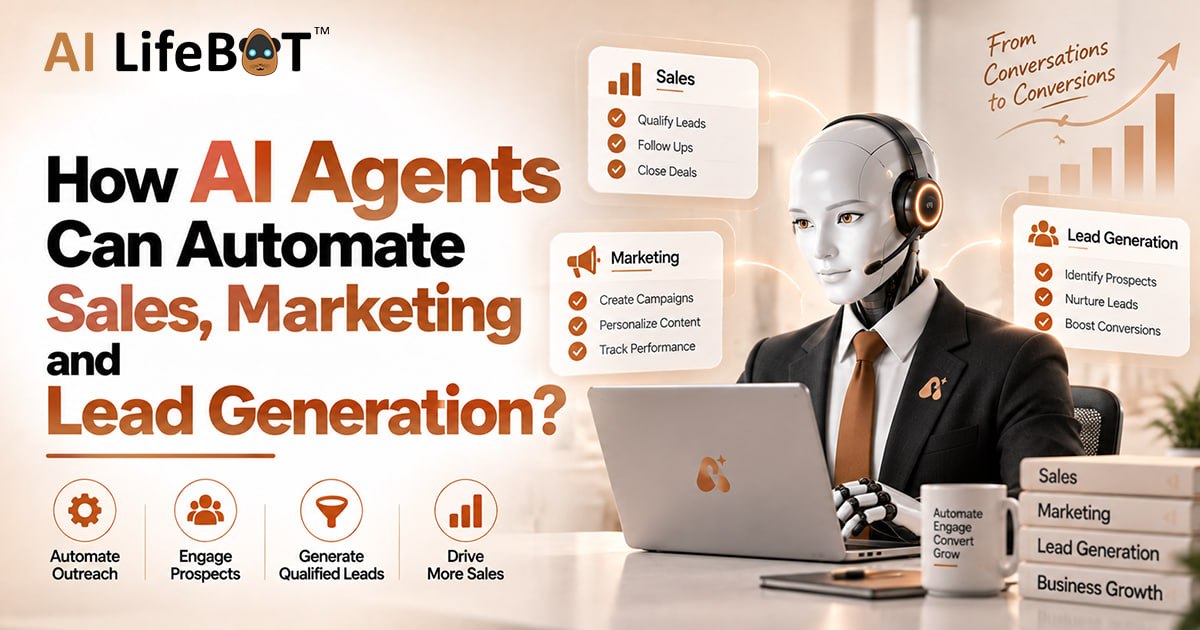
Sales used to mean waiting for leads.
Marketing meant sending campaigns, checking spreadsheets, chasing responses and hoping someone clicked the right button. Lead generation? Often a messy mix of forms, phone calls, WhatsApp messages and follow-ups that somehow ended up being handled manually.
That model is changing.
AI agents are stepping into the gaps.
Unlike a basic chatbot that simply answers pre-written questions, modern AI agents can understand conversations, collect information, qualify prospects, trigger workflows and keep an interaction moving towards a useful next step. For businesses trying to scale without throwing more people at every repetitive task, that's a pretty big shift.
And this is where AI LifeBOT fits into the picture.
AI Agents Are Changing the Sales Process
Think about what happens when a potential customer visits a website at 11:47 PM.
They have a question. They want pricing. They want to know whether a service fits their business. Nobody from the sales team is online.
The old answer? Come back tomorrow.
An AI agent can start the conversation immediately.
With AI Agents Sales Marketing applications, businesses can engage visitors, understand their intent, ask qualifying questions and capture relevant information before handing the prospect to a human sales representative. The conversation doesn't have to begin again from scratch either—the information gathered during the interaction can help the sales team understand what the prospect actually wants.
That's useful.
Because salespeople should spend more time selling and less time asking, "So, what exactly are you looking for?"
Marketing Gets More Responsive
Marketing isn't just about attracting attention anymore. It's about responding to that attention quickly.
Someone downloads a brochure. Someone asks about a product on WhatsApp. Another visitor spends five minutes exploring a service page but doesn't fill out the contact form.
These are signals.
An AI agent can respond to such interactions, answer common questions, recommend relevant information and guide prospects towards the next action. Depending on how the workflow is designed, it can also connect conversations across channels and pass qualified leads into existing business systems.
This makes Sales Support AI Agentic solutions particularly interesting for growing teams.
The word "agentic" matters here.
The system isn't merely waiting for a question and producing an answer. It can be designed to take action within a defined workflow—collecting details, checking information, initiating a task or escalating a conversation when human intervention makes more sense.
Not everything needs a human.
But the things that do should reach one at the right moment.
Lead Generation Doesn't Have to Stop at the Form
Website forms are useful. They are also easy to abandon.
A visitor sees six compulsory fields and thinks, "I'll do this later."
They rarely do.
A conversational lead generation system can make that process feel less like paperwork and more like an actual interaction. Instead of presenting a blank form, an AI agent can ask questions naturally, one step at a time.
What service are you interested in?
What problem are you trying to solve?
When are you looking to get started?
Those answers can help businesses distinguish casual enquiries from sales-ready prospects.
For organisations looking for a Lead Generation Chatbot Company in Noida, AI-powered conversational systems can provide a practical way to combine automated engagement with structured lead capture.
What Happens After the Lead Arrives?
This is where many automation strategies fall apart.
Generating 500 leads sounds fantastic until a sales team has to manually sort, qualify and follow up with every single one.
AI agents can help create structure around that chaos.
They can categorise enquiries, collect missing information, answer repetitive questions and route conversations according to predefined business rules. A high-intent prospect can be directed towards sales. A support-related query can go elsewhere. A simple product question can be handled automatically.
Fewer bottlenecks.
Cleaner handovers.
Faster responses.
And potentially, a sales team that isn't drowning in routine conversations.
The Human Team Still Matters
AI isn't replacing the person who closes a complex enterprise deal over one coffee.
That's not the point.
The real opportunity is to let AI handle the repetitive layer surrounding sales and marketing while people focus on judgement, relationships, negotiation and high-value conversations.
That's the sweet spot.
With AI LifeBOT, businesses can explore AI agents across sales, marketing, customer engagement and lead-generation workflows—building automated conversations that don't simply talk, but help move prospects and processes forward.
Because the future of sales probably won't be completely human or completely automated.
It'll be smarter than that.