
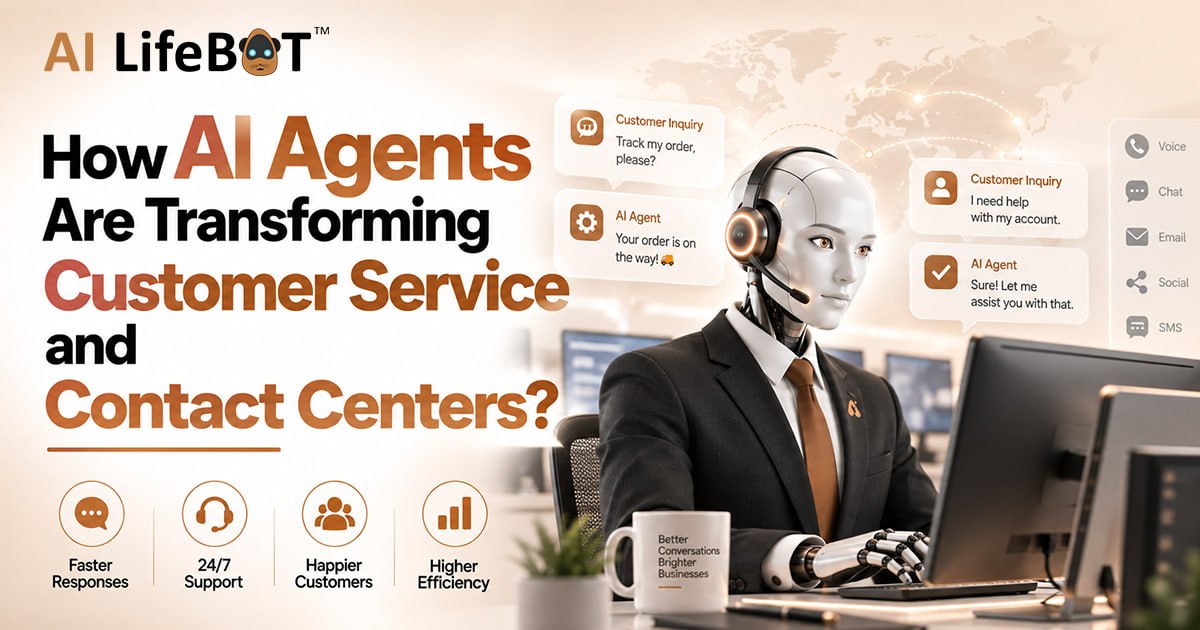
Customer service used to mean waiting.
Waiting for an agent to answer. Waiting while they searched for an order number. Waiting again when the call had to be transferred to another department. One small question could somehow become a twenty-minute conversation.
That model is changing.
AI agents are turning customer support from a queue-based operation into something far more immediate, responsive, and conversational. Instead of simply following a fixed script, modern AI agents can understand what a customer is asking, interpret the context, retrieve relevant information, and respond in real time. That's a significant shift for businesses handling hundreds—or thousands—of customer interactions every day.
AI Agents Customer Service: Beyond the Basic Chatbot
There is a difference between a chatbot that throws predefined answers at customers and an AI agent that can actually work through a problem.
That's where AI Agents Customer Service solutions are gaining attention.
Imagine a customer messaging a company at 11:47 p.m. because their payment has gone through but their order status hasn't changed. A conventional bot might display three menu options and eventually say, "Please contact support during business hours."
An intelligent AI agent can take a different route. It can understand the complaint, ask for the necessary information, check connected systems, explain what happened, and—where the workflow allows—initiate the next action without forcing the customer to start over with a human representative.
Less friction.
Better conversations.
And, importantly, fewer repetitive tickets landing in an already crowded support queue.
AI Agents Contact Center Operations Can Actually Use
Contact centres are complicated places. Calls arrive at unpredictable times, agents juggle multiple conversations, customers repeat themselves, and managers constantly watch metrics such as response time, resolution rates, and abandoned calls.
This is where AI Agents Contact Centre technology becomes particularly useful.
AI agents can handle routine enquiries, qualify customer requests, route conversations, collect information before escalation, provide status updates, and support human agents with relevant information during live interactions. The goal isn't necessarily to remove people from the equation.
It's to stop making people answer the same question for the 300th time that afternoon.
With a platform such as AI LifeBOT, businesses can build AI-powered interactions across voice and chat channels, creating automated experiences that remain available beyond traditional working hours. When an issue becomes too complex or sensitive for automation, the conversation can be handed to a human agent with the relevant context intact—so the customer doesn't have to tell the whole story again.
That small detail matters more than it sounds.
The Rise of the AI Agent Live Chat Agent
Live chat has always promised speed. AI is making that promise easier to keep.
An AI Agent Live Chat Agent can respond instantly, handle multiple conversations simultaneously, and maintain a conversational flow rather than forcing every visitor through rigid menus. A customer asking about pricing may receive one type of response; someone reporting a technical problem can be guided through troubleshooting; another visitor may simply need help finding the right service.
Different intent. Different conversation.
The interaction adapts.
For businesses, this creates an interesting balance: customers get immediate assistance while human support teams can concentrate on situations that genuinely require judgement, empathy, negotiation, or specialist knowledge.
And that's probably the better use of human talent anyway.
What About Local Customer Support?
The same approach works at a regional level.
A Customer Support BOT in Noida, for example, can help businesses serving customers across Noida, Delhi NCR, and other markets manage common enquiries without making customers wait for office hours. Whether the interaction involves service information, appointment-related questions, order updates, or basic troubleshooting, an AI-powered support layer can keep conversations moving.
AI LifeBOT brings this broader idea together through conversational AI, allowing businesses to create customer-facing agents designed around their specific workflows rather than forcing every company into the same generic support model.
The real transformation isn't about making customer service less human.
It's about making it less exhausting.
When AI agents handle the predictable questions, human teams have more room for the unpredictable ones—the angry customer who needs reassurance, the complicated case that requires judgement, the conversation where listening matters more than speed.
That's where customer service starts becoming better, not merely faster.