
AI can answer questions. It can write emails. It can analyse a spreadsheet before you’ve finished your morning coffee.
But that’s only the surface.
The more interesting shift is happening with AI agents—systems designed not just to respond, but to take action, make decisions, use tools, and work towards a defined goal. And then there’s the next layer: AI Multi Agents, where several specialised AI agents work together instead of forcing one system to handle everything.
Sounds similar?
It isn't.
What Exactly Is an AI Agent?
Think of an AI agent as a capable digital worker with a job to do.
You give it an objective. It interprets the request, gathers information, reasons through the situation, uses available tools, and takes the next appropriate action. A customer service agent, for example, might understand a customer's complaint, check an order record, identify the issue and initiate the right support workflow.
One agent. One primary responsibility.
That doesn't mean it is simple. A good AI agent can handle surprisingly complicated workflows because it can make decisions along the way rather than following one rigid script.
This is where platforms such as AI LifeBOT become interesting. Instead of treating conversational AI as a glorified FAQ box, AI LifeBOT focuses on deploying intelligent agents for practical business functions such as customer service, sales, recruitment, operations and support.
The difference is subtle until you see it working.
A chatbot says, “Here is the information.”
An agent can say, “I understand the problem. I checked the relevant details. Here's what needs to happen next,” and then actually trigger the appropriate process.
So, What Is a Multi-Agent System?
Now imagine giving that same business problem to a team instead of one worker.
One AI agent handles customer conversations. Another checks data. A third handles a sales qualification task. Another manages an internal workflow.
They communicate.
They divide responsibilities.
They coordinate.
That's the basic idea behind an AI Multi Agents architecture.
Rather than building one giant AI system that knows how to do everything—customer support, sales, analysis, scheduling, compliance, reporting and a dozen other jobs—you can create specialised agents and allow them to collaborate.
It's a little like running a busy restaurant. You wouldn't ask the chef to greet customers, manage reservations, prepare every dish, collect payments and wash every plate. Different people handle different jobs, yet the restaurant still functions as one operation.
AI Multi Agents follow a similar logic.
The Real Difference
The easiest way to understand the distinction is this:
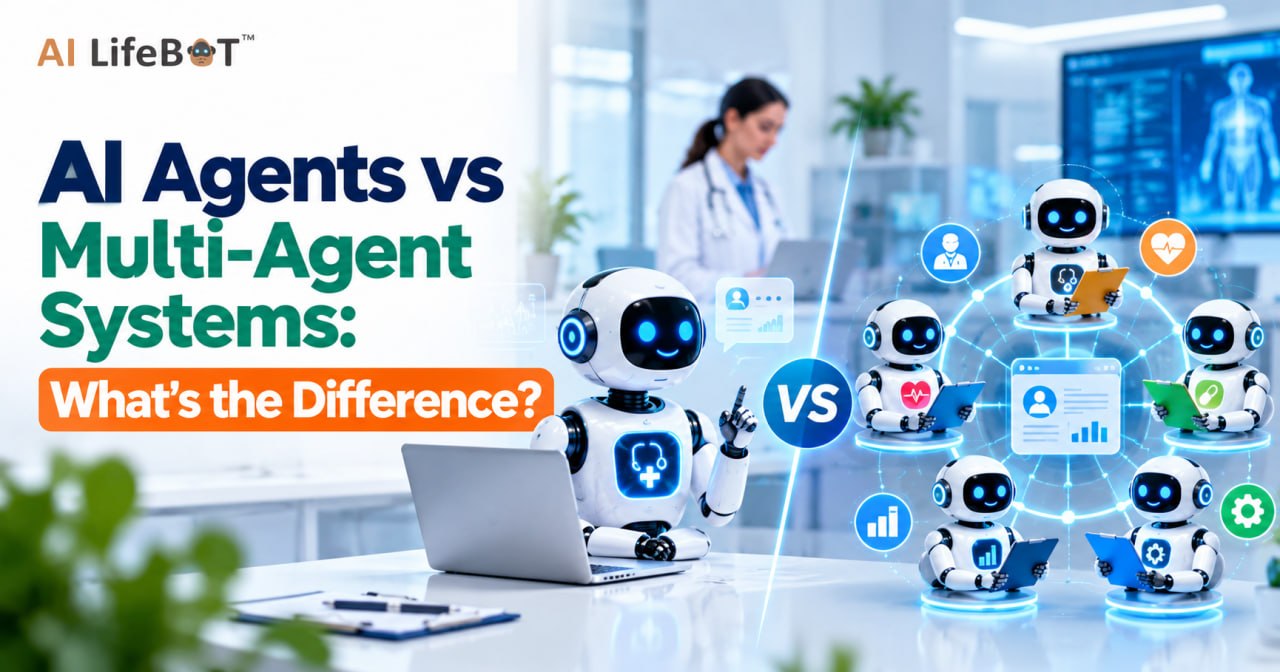
AI Agent: One intelligent system working towards a goal.
Multi-Agent System: Multiple intelligent systems working together towards a larger goal.
That difference matters when workflows become complicated.
Suppose a company receives a new customer enquiry. A single AI agent could qualify the lead and respond. But a multi-agent setup could split the work: one agent understands the enquiry, another evaluates the lead, another checks relevant customer information, and a sales-focused agent prepares the next action.
Suddenly, the workflow isn't just conversational.
It's coordinated.
Which One Should a Business Use?
There isn't a prize for choosing the more complicated architecture.
If one agent can handle the job effectively, use one.
Multi-agent systems make more sense when the process involves several specialised tasks, different tools, multiple decision points or independent workflows that need to cooperate.
That's where platforms like AI LifeBOT can play a useful role—helping businesses move beyond isolated chatbot interactions towards more structured AI-driven automation.
And honestly, that's probably the bigger story.
AI isn't simply becoming better at talking.
It's becoming better at doing.
The next generation of business automation won't necessarily depend on one super-intelligent AI trying to run everything. It may look more like a digital team—specialised agents handling specific responsibilities, exchanging information and pushing a workflow towards its final outcome.
One agent is useful. A coordinated group can be something else entirely. And that distinction is where AI Multi Agents start to become genuinely powerful.