
Paperwork. Delays. Endless follow-ups.
Nobody enjoys them.
Whether you're waiting for an insurance claim to be approved or trying to book a hospital appointment, the experience often feels slower than it should. You fill out forms. Someone reviews them. Another person asks for the same information again. Days disappear, sometimes weeks. That's exactly where AI Agents Insurance and AI Agents Healthcare are beginning to change the story—not by replacing people, but by removing the frustrating parts that never needed a human touch in the first place.
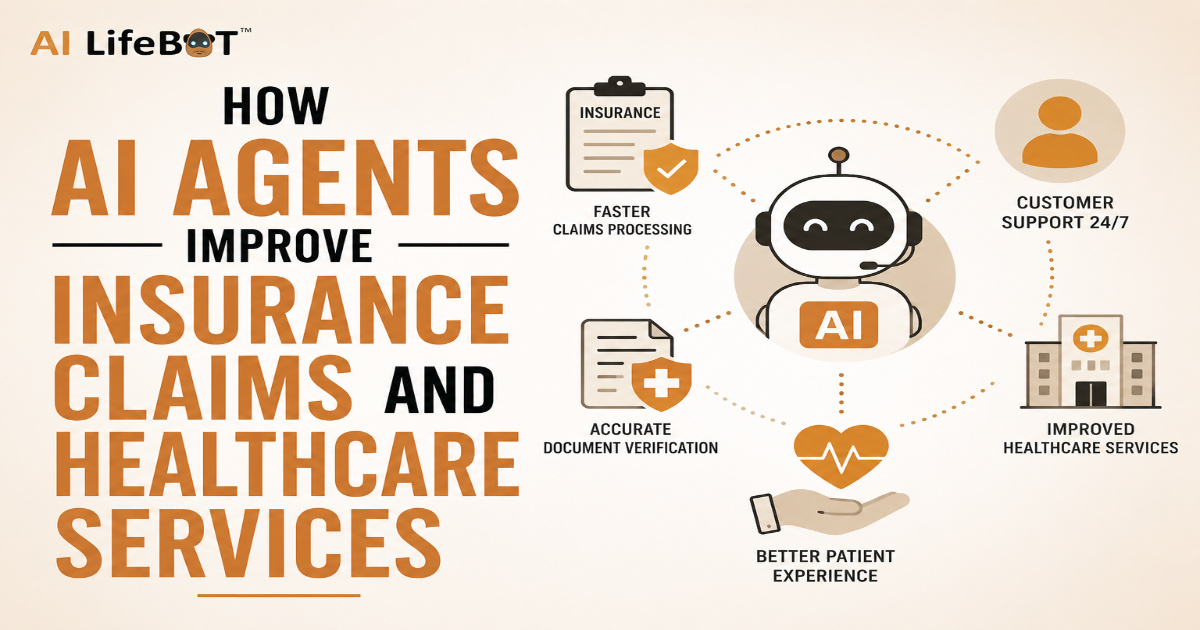
Take a simple insurance claim after a minor car accident. A customer uploads photographs, shares the policy number, and explains what happened. Traditionally, those details would bounce between departments before anyone made progress. An intelligent AI agent, however, can verify policy information, categorise the claim, identify missing documents, detect unusual patterns that may require additional review, and route everything to the correct claims officer within minutes—while keeping the customer informed at every step. That's not science fiction anymore. It's becoming the new standard.
This is exactly where AI LifeBOT is making a measurable difference.
Insurance companies don't struggle because their teams aren't capable. They struggle because thousands of repetitive requests arrive every single day. Policy enquiries. Renewal reminders. Claim status updates. Document verification. Premium calculations. Imagine asking a highly trained executive to spend eight hours every day answering, "Has my claim been approved yet?" It doesn't make much sense.
An AI agent never gets tired.
It never forgets.
It doesn't need a coffee break.
Instead, it works around the clock, responding instantly, collecting accurate information, and allowing insurance professionals to concentrate on complicated claims that genuinely require judgement and experience. That's the real promise behind modern AI Agents Insurance—they reduce waiting time without sacrificing service quality.
Healthcare tells a similar story, although the stakes are much higher.
When someone contacts a hospital, they're rarely doing it for fun. They may be anxious about test results, trying to schedule surgery, searching for the right specialist, or simply wondering whether a symptom needs immediate attention. Waiting on hold for twenty minutes only adds to that anxiety.
Now imagine a healthcare AI agent handling the first interaction.
It can book appointments, guide patients to the appropriate department, answer common medical service questions, send prescription reminders, collect preliminary patient information before consultations, and even follow up after discharge—all while seamlessly handing over complex conversations to medical staff whenever necessary. Patients feel heard faster, doctors spend less time buried under administrative work, and hospitals operate with noticeably better efficiency.
Simple.
But surprisingly powerful.
Healthcare administration often resembles trying to untangle a box of old charging cables. Everything connects to everything else, yet finding the right thread takes longer than expected. Intelligent AI agents help organise that complexity. They don't replace compassion or clinical expertise; they create more space for both.
That's one reason organisations are increasingly adopting platforms like AI LifeBOT.
The platform enables businesses to deploy intelligent AI agents that manage conversations across multiple channels, automate routine workflows, and integrate with existing business systems. Whether the goal is improving customer support for insurers or streamlining patient engagement for healthcare providers, the focus remains the same: faster responses, fewer manual tasks, and consistently better experiences.
Of course, AI isn't perfect.
Not every insurance claim can be approved automatically. Not every patient enquiry should receive a fully automated response. Sensitive cases still need experienced professionals who understand context, emotion, and nuance, which brings us to the real point.
The smartest organisations aren't choosing between humans and AI.
They're building teams where both work together.
AI handles repetitive processes with speed and precision, while people focus on empathy, strategic decisions, and solving unusual situations that technology alone can't fully understand.
The future of insurance and healthcare won't be defined by bigger call centres or thicker instruction manuals. It'll be shaped by organisations that eliminate unnecessary friction before customers even notice it exists.
That's exactly where AI LifeBOT delivers value.
By combining intelligent automation with conversational AI, businesses can create faster insurance claims journeys, more responsive healthcare services, and customer experiences that feel effortless instead of exhausting. In industries where every minute matters, that's not merely an operational improvement—it becomes a competitive advantage.