
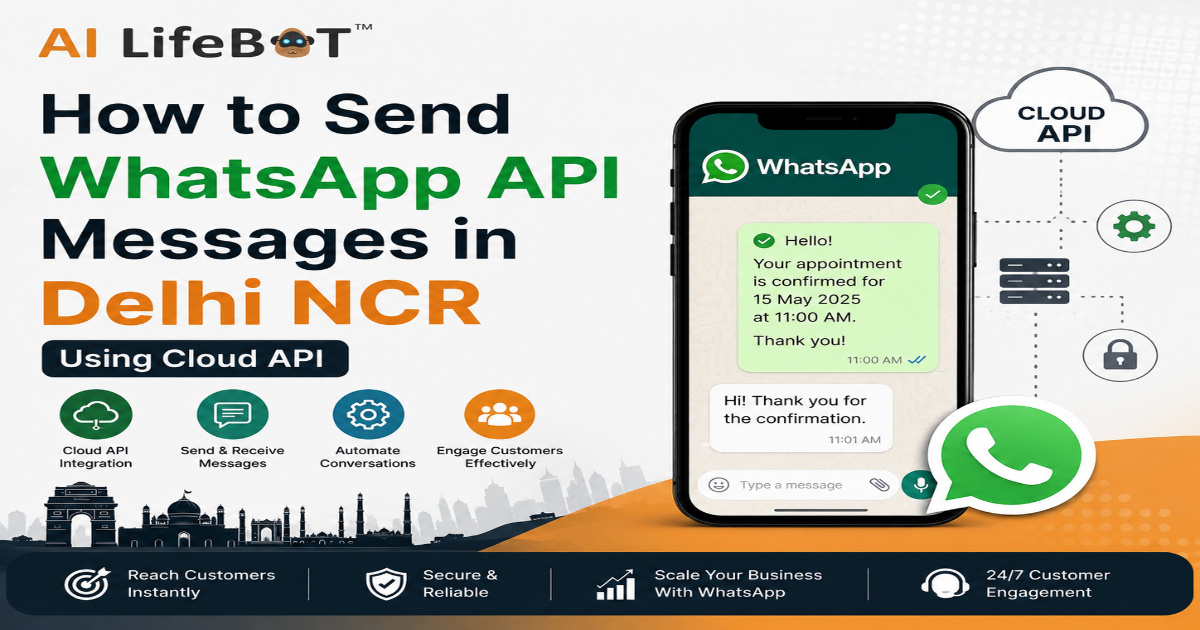
WhatsApp is no longer just where people send “Hi” and wait for a reply. Businesses use it to confirm appointments, answer customer questions, share updates, qualify leads, and keep conversations moving when their teams are busy. In Delhi NCR, where customers often expect a quick response, that speed can make a real difference.
That is where the WhatsApp Cloud API comes in.
But here's the thing: using WhatsApp for business at scale isn't the same as opening the app on a phone and sending messages one by one. You need an API connection, proper business setup, approved message templates where required, and a system that can handle incoming and outgoing conversations without turning your team into a permanent typing squad.
What Is WhatsApp Cloud API?
WhatsApp Cloud API is Meta's cloud-hosted interface that allows businesses to connect WhatsApp with their software, CRM, customer support platform, or AI system. Instead of manually replying to every customer, businesses can trigger messages through connected systems and automate parts of the conversation.
For a Delhi NCR business, imagine a customer filling out a property enquiry form at 10:47 p.m. The system can acknowledge the enquiry on WhatsApp, collect basic information, and route the conversation to the right team.
Instantly.
That is the practical appeal.
How to Send WhatsApp API in Delhi NCR
The process starts with setting up the required WhatsApp Business infrastructure and connecting it with the Cloud API. Businesses generally need an appropriate Meta business setup, a WhatsApp Business account, a verified business identity where applicable, and a phone number configured for API use.
Then comes the technical part: connecting the API to your business application.
This is where many businesses hit a wall—not because WhatsApp is complicated, but because APIs don't care that someone in the sales department “just wants to send a message.” The system needs authentication, message requests, webhooks for incoming conversations, and carefully structured workflows.
Once connected, businesses can create automated communication flows for lead follow-ups, booking confirmations, support queries, reminders, notifications, and other customer interactions.
Using Cloud API WhatsApp in Delhi
Choosing a Cloud API WhatsApp in Delhi setup makes sense when your business needs more than basic messaging. A restaurant could confirm reservations. A healthcare organisation could send appointment reminders. An education company could respond to admission enquiries. A logistics business could automate delivery updates.
Different industries. Same problem: too many conversations and not enough hours in the day.
AI can take this further.
With AI LifeBOT, WhatsApp can become part of an intelligent customer engagement workflow rather than simply another inbox. AI-powered agents can understand customer queries, respond conversationally, retrieve relevant information, and help automate repetitive interactions across business processes. AI LifeBOT positions its solutions around enterprise AI agents and customer engagement across channels, including WhatsApp.
Why Businesses Should Consider AI-Powered WhatsApp Automation
Sending an API message is easy enough. Building useful conversations is harder.
Customers don't always type neat questions. They send “price?”, then disappear for three hours. They send screenshots. They change their minds halfway through a conversation. A rigid bot can struggle here.
An AI-powered system can interpret intent and context more naturally, while automation handles repetitive steps behind the scenes.
For businesses looking to Send Whatsapp Api in Delhi NCR, this combination can help create faster responses without forcing employees to manually handle every routine interaction.
The Real Goal Isn't Sending Messages
It is getting conversations somewhere.
A WhatsApp message should ideally lead to an answer, an appointment, a qualified lead, a resolved support issue, or another useful action. Otherwise, you're just creating another notification.
AI LifeBOT brings AI agents into that equation, helping enterprises automate customer interactions and workflows while keeping WhatsApp as a familiar communication channel. Its platform is designed for enterprise-scale AI engagement and integrations across multiple channels.
For businesses across Delhi NCR, that makes Cloud API WhatsApp more than a messaging tool.
It becomes infrastructure.
And once conversations start flowing through an intelligent system, the question changes from “How do we send a WhatsApp API message?” to something much more interesting: